all about the body by mrm

I know that all my news is old news, but I just saw The Wrestler. I think that unflinching is overused as an adjective at the moment, so I'll settle for calling it extraordinarily clear-eyed, or perhaps unblinking.

Yes, the acting is fantastic and the film is entertaining and suspenseful - that's all well and good and true and I don't want to belittle any of it for a moment - but I'd like to take that as read, and move on to what truly fascinated me about this film. I don't know much about professional WWE wrestling that I didn't learn from the film, but the portrayal of gender behaviors and expectations, of American youth-worship and celebrity culture was what I found surprising and insightful.

This isn't the only film about men fighting in rings that I've seen recently; a few weeks ago I saw Fat City, which I enjoyed for its gorgeous washed-out color, its spot-on acting, and rambling yet well-crafted dialogue. It was not particularly generous towards its female characters, however - while it exhibited a profound sympathy for the tragedy of masculinity, the impossibility of maintaining the standards of the hyper-masculine ideal with age, it seemed unwilling to extend an equal regard to the women of the film. The Wrestler, however testosterone-fueled it may be, is well aware that the conformity and inflexibility of strict gender roles ultimately benefits no one. Furthermore, it shows that the achievement of the gender ideal is like the line on a bell curve - some points may be closer than others, but it will stretch out to infinity without meeting zero. Perfection is tauntingly, terribly, eternally out of reach. The film illustrates the despair this creates, the impossibility of any outcome besides failure. It also critiques the frantic USAmerican chase after youth and youthfulness, our cultural rejection of aging. It portrays the desperation, the almost-groveling willingness to please that stems from a sense of the feminine that is based exclusively on sexual attractiveness to men. Finally, it depicts the transience of fame, and the almost helpless, heedless, and oddly heartbreaking pursuit of celebrity that seems to guide so much of contemporary life and culture.

Talk about your pleasant surprises.

impossible, impossible by mrm


I won't say you have to see it, because I hate it when people say that to me.

I will say that I was amazed, astounded, and awestruck by Man on Wire. It is one of the only films I think I've ever seen that was literally breathtaking. I'm not only speaking for myself. I was in a small theatre, and I could hear the other audience members gasping. At one point, the woman sitting in front of me muttered Calm down only to draw in her own breath sharply moments later.

After being apprehended by the police, Philip Petit is asked over and over why he snuck into the Twin Towers, strung a highwire between them, and walked back and forth across it. He was 1,350 feet high in the air. Why? he responds, There is no why.

I thought it was extraordinary.

on to bigger and better things by mrm

This just in:
Obama to quit the presidency, become Armani model


Said the soon-to-be-ex-President, "I'm tired of Michelle getting all of the fashion press. I've got a unique sense of style, and I really don't feel that I'm given enough opportunity to express myself, clothing-wise, in my current job."

ring my bell by mrm

It always surprises me when people live up (or down?) to their cultural stereotypes.

I live in a "WG" (pronounced "Vay-geh;" short for Wohngemeinshaft, or shared apartment) with two other people. Our WG is in a four-story apartment building. There are eight flats. In Germany, or at least in Bavaria, there are no apartment numbers. Instead, the building has a number and each person's mailbox in the hallway has their name on it and that's how we get our mail. Outside our apartment building we have a shiny brass plate sort of thing with everyone's name next to their respective doorbell. The names are not engraved; rather, your name is on a little piece of paper inside a sort of slipcase. In January, when I moved in, we updated our nameplate and mailbox accordingly. Unfortunately, in the process of doing so we lost one of the tiny brass screws that affixes our nameplate to the wall. We tightened the other screw, though, and the name plate sat quite correctly in its proper position, nicely parallel to the one below it. However, about three weeks ago, one of our neighbors stopped one of my roommates on the stairs and said we really should replace the screw. (Did I mention that we are by far the youngest people in the building? The next closest in age are in their late thirties, I suppose. The oldest is probably around seventy.) As of just over two weeks ago, the screw has been replaced.

We received a hand-written note today in our mailbox. Dear WG, it said, It would be nice if you would replace the screw on your name plate with one that matches...It would be so nice if it didn't look "messy." Kind regards, Your Neighbor.

I find the anonymity amusing. And it's true, the screw we used to replace the one that disappeared (despite much searching!) amid the tiny stones and dirt of the flowerbed doesn't match. It's silver and it's slightly too big (this was a tiny, tiny screw), so it sticks out from the frame by about one centimeter. Clearly, this is an eyesore.

So, my plans for Monday (every single store is closed in Bavaria on a Sunday) include going to the hardware store to search for a tiny, tiny brass screw.

I won't ask for a cup of sugar anytime soon.

Zusammengesetztes Hauptwort by mrm

I'm really enjoying learning German. I wish it was because I was some kind of language genius and would be fluent in a month or that I was planning on reading Goethe in the original or something else suitably impressive. But really, it's out of absurdity. German words are often extraordinarily long (by English standards), but they have an even more extraordinary – if in some ways relentlessly pragmatic – poetry that I find increasingly irresistible.

I am speaking, of course, about the Zusammengesetztes Hauptwort, or compound noun. This part of speech flourishes in the climate of the German language in a way that makes its languishing English cousin cry in the corner in despair, rubbing its tears into the wallpaper. The creation of new words in German seems to have been extremely economical; whenever possible, two existing nouns were stitched together to create a new and entirely logical noun. If you know what the pieces mean, you probably don't even need to look up the English equivalent in your words book – I mean, dictionary. Allow me to offer my favorite samples thus far; see how you do:

1. Haustier – house animal
2. Handschuhe – hand shoes
3. Kinderwagen – child car
4. Mittagsessen – midday eating
5. Tierpark – animal park
6. Vorband – before band
7. Staubsauger – dust sucker
8. Wasserkocher – water cooker
9. Fußboden – foot ground
10. Worträsel – word puzzle
11. Taschenlampe – pocket lamp
12. Sommersprossen – summer sprouts

Wasn't that fun?

Surely you're not still resisting the charms of German? What if I told you that they have a special verb for watching television (fernsehen – to TV see), and for eating breakfast (frühstücken – to breakfast)?

You can't hold out forever.

(1. pet, 2. gloves, 3. stroller, 4. lunch, 5. zoo, 6. opener, 7. vacuum cleaner, 8. electric kettle, 9. floor, 10. riddle, 11. flashlight, 12. freckles)

Weihnachtenalptraum by mrm

I feel that the mythical world is seeping into mine.

I think it's generally agreed upon by the participants that in the U.S., Christmas is a wildly commercial but generally cheerful and chocolaty time. Despite the warning to misbehavers of no presents and coal in their stockings, the threat is assumed by all to be idle. Santa Claus is a gentle man, willing to forgive your sins and transgressions. Sort of an older, fatter, jollier Jesus. In parts of Germany, however, there are still links to a wilder and weirder time. Santa Claus has henchmen, and not your usual toy-making elves, tiny and non-threatening in curly-toed shoes. In the Bavarian Alps, children are threatened with the Krampus.

The Krampus is Santa's helper. He metes out the punishment that jolly old S.C. just can't bring himself to inflict. In the Alpine towns, usually around the 5th or 6th of December, the young men dress as the Krampus, and walk through the street, chasing children and occasionally young women. They look scary (imagine if you were about four or five years old, and this happened in your house, or if you were walking to school one morning, and you saw this coming down the road towards you). Long-toothed terrifying demons with long horns, clanking bells and waving sticks!

I think if I had been a child in such a town, this would have given me nightmares for life.

(a thousand thanks to Maxi, without whom I never would have dreamt of any of this.)

Pergamon p.s. by mrm


According to the good people at the Pergamon, the Sirrush (Der Muschchuschu, or "splendor serpent") "...is the symbolic animal of the Babylonian patron deity Marduk.* The three-dimensional relief portrayal of the dragon is to be found on the gate of Ishtar of Babylon which was erected in the early 6th century by King Nebuchadnezzar the II.

The mythical creature is composed of a reptile's body, the head of a horned viper, the front paws of lion, the hind leg of an eagle and the tail sting of a scorpion."

Sorry chimera, I think I have a new favorite mythical animal.


*wikipedia notes that his specialties included "water, vegetation, judgement, and magic." Useful sort of fellow.

Open Letter by mrm

Dear Mr. Thomas Mann,

It is with a heart neither particularly heavy nor particularly light that I bid farewell to your hero, a Mr. Hans Castorp. He was a tranquil if somewhat hypochondriacal chap, unlucky in love and life in general, and overly fond of cigars.

I would, however, like to offer you my sincere gratitude for the following:

"You have never spent any time in theatrical circles, have you? So you do not know those thespian faces that can embody the features of a Julius Caesar, a Goethe, and a Beethoven all in one, but whose owners, the moment they open their mouths, prove to be the most miserable ninnies under the sun." (translated from the German by John E. Woods)

That certainly produced a chuckle.

Also, words cannot convey the depth of my indebtedness to you for having introduced me to that marvelous word and concept, philopena.

phil⋅o⋅pe⋅na
a custom, presumably of German origin, in which two persons share the kernels of a nut and determine that one shall receive a forfeit from the other at a later time upon the saying of a certain word or the performance of a certain action. (dictionary.com)

I can think of but few things I like more.

With my warmest regards, etc.

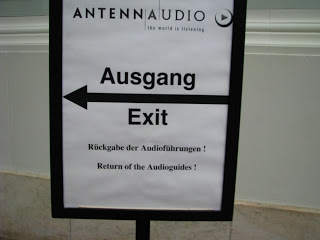
Not Ausgang by mrm

Ah, Berlin: city of culture, of hipness, of music, of whimsy. An extremely high number of people in Germany speak decent to fantastic English. Many of them live in the country's dashing, cosmopolitan Haupstadt. Which makes the lamentable translations found all around the Pergamon, a truly extraordinary museum, all the more inexplicable:


This is pure camp. Summer camp. Bonfire and s'mores.

Deutsch als Fremdsprache by mrm

I had my first Deutschkurs today. There are about fourteen students, and we're from: Romania, Rwanda, Vietnam, Poland, Greece, Brazil, Hungary, Nigeria, Kosovo, Italy, Iraq, Ghana, and the U.S (just me). Our teacher is a Romanian who speaks German, English (and Romanian, of course), and understands Spanish and Italian. I've already realized that I have difficulty understanding the German of some of my fellow students because they have an accent that is (understandably) different than mine or that of the Bavarians I'm accustomed to listening to. I'm below the average age of the class, but the youngest by far is the 19-year-old Italian guy who blushed to the roots of his hair when the teacher talked to him. He claims to understand no German whatsoever, which made me volunteer my terribly faded and tattered Italian in a more or less successful attempt at assistance once or twice. Not everyone speaks English. Currently, we have no lingua franca. We'll see how this develops over the next two and a half months.

While I'm still in immeasurable awe of people who are fluent in more than one language, it has been my sad conclusion of late that, in contrast to an idea I once cherished, such fluency does not confer upon the speaker True Genius. Some people who are bi- or trilingual are capable of perfect idiocy in multiple languages. This is depressing.

what's the word for "confused horror?" or perhaps, "horrified confusion?" by mrm

As you can probably guess from the title, I just watched some clips from the Oscars. Now, I could employ a variety of rude expressions to express my utter disdain for this awards ceremony, but I won't bother. Suffice it to say that I was not the least dismayed to wake up Monday morning and not know who won, nor was I surprised when I eventually found out. This is despite the fact that I haven't seen any of the films nominated in the major categories.

Longstoryshort: When I eventually roused my somnolent curiosity enough to go to youtube, I was surprised to see that the first musical number had at least (or at most, I'm not going to bother to watch it again to check) three good jokes: 1) Frost and Nixon in love/Anne Hathaway inexplicably Richard Nixon, 2) I haven't seen "The Reader," and 3) I am Wolverine! Unfortunately, this raised my Oscar expectations from zero to something, and I proceeded to watch the Jackman/Beyoncé medley. Although I've recently developed an odd crush on Beyoncé (I like it when she tells the single ladies what to do with their hands. help me!), this bit of business sunk far below my worst imaginings. I kid you not, we did better Broadway medleys in my high school choir. My facial muscles are still sore from various expressions of revulsion.