OMFG (O Mein Faschings Gott) by mrm

I think I have to admit to a certain naïveté in my expectations for Fasching. But unlike, say, the Oktoberfest, I had never heard of it before I came to Germany, and so in perfect honesty and wide-eyed wonder I did expect something like a folk festival. The idea of Fasching (so I have been told) is to "drive out the winter." Pagan stuff, merged in weird ways with Catholicism, so that all Faschings parties are supposed to end at the stroke of midnight; otherwise, Jesus turns everyone into a pumpkin for Lent.


So, on Faschingsdienstag (Shrove Tuesday), which is the final, maddest day of them all, I went to the Viktualienmarkt, reputed to be the hub of Faschings action. If the Oktoberfest was the ultimate expression of kitsch, then I think Fasching must be the transcendent embodiment of tackiness. Really loud, really trashy popped-up versions of unexpected songs attacked from all sides. It was snowing steadily, but everyone was there, drinking beer at noon under umbrellas. Most costumes were of the 5-things-that-don't-go-together-suddenly-together! variety. Neon was dominant. The next most popular costume was "Indians" in the style of Hollywood's Golden Age (of Ignorance and Cultural Appropriation). I also saw two men in blackface. (question mark, exclamation mark, question mark, shock). Then, unlike most of Munich, I went to work.

of uncertain parentage part II: or, sui generis? by mrm

This forc'd through many tedious sweating Years
The patience of the earnest Student; who
Consumed with a thousand pallid Cares,
Amidst his painful Work could nothing do.
For to inrich his Tongue, his Brains he brake,
And aged grew e'r he had learn'd to speak.

Strange scrambling Alphabets this multiply'd,
And to an Art improv'd Necessity;
Each parted Tongue this did again divide
Into Eight several Stations, and by
Unworthy Grammar's busy Niceties
All generous Apprehensions exercise.

Yea Grammar too found all her Laws too weak
To govern Language's extravagance;
Such odd and unruly Idioms did kick
Against her setled Discipline, and prance
So wildly through Expression's fields, that Art
Was fain to play the child, and conne by heart.

-Francis Beaumont, Psyche

of uncertain parentage: the first candidate by mrm

"Sometimes the sudden alteration in point of view depends on the ambiguity of the language...I strongly suspect that of all languages English lends itself the most easily to all these ambiguities of word and phrase. It has the largest vocabulary of any language, and a vocabulary, moreover, drawn from the most various sources. It is, of all the major languages, the most disorderly in spelling and the least inhibited in grammar. It is most widespread over the world, most spoken by those whose first language is something else, most dialected, most distorted, most mangled - and it has survived it all.

The result is that more games can be played with it than with any other language, and to anyone who loves English - who truly loves it - who loves the intricacies of its countless words and phrases and all its ridiculous and unruly idioms, those games represent the purest fun one can have with nonmusical sounds.

I will admit that I am intoxicated with English and that not everyone is...

But what can I do?"
- Isaac Asimov, Isaac Asimov's Treasury of Humor

same procedure by mrm

I was giving some instructions to one of my shyer students when he gave me a look that I can only describe as impish and asked me "Same procedure as last year?" At this, the other students (eight exceedingly tall German men, all in their 30s and 40s, all of whom work on airplanes, and all of whom semi-regularly pretend to be afraid of me because I'm so strict) burst into laughter. I voiced my confusion, and demanded to be let in on the joke. They were shocked that I was unfamiliar with their source material, "Dinner for One, or: The 90th Birthday."

They explained to me that this short film is shown on German television every year on New Year's Eve. Apparently it's a cult classic in Germany, and in a few other places on the Continent as well. This is despite (or perhaps because of) the fact that it is almost entirely in English, and unsubtitled. It's about 18 minutes long, black and white, and stars two British actors completely unknown to me, Freddie Frinton and May Warden. The sketch was originally written in the 1920s, but gained lasting fame with the 1963 recording for German television. It's funny, in an overblown-physical-comedy, light-heartedly alcoholic, British sort of way. If you feel so inclined, enjoy.

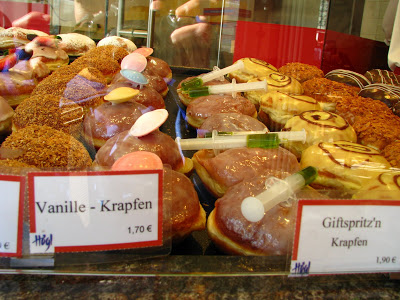
Krapfen by mrm


Doughnut season is in full, bewildering swing. Krapfen (like doughnuts, with various fillings but no holes) are omnipresent, and available in overwhelming varieties. I present here a sampling from one bakery, which currently offers a call-a-krapfen service (my translations are offered as necessary; names range from the bizarre to the potentially inappropriate, at least for a pastry):
  • Der Klassiker - Marillenkonfitüre (The Classic - apricot jam)
  • Amaretto-Marzipan
  • Himbeer (raspberry jam)
  • Baileys - Vanillapudding mit Baileys
  • Kürbis-Kokos - Kürbiskonfitüre mit Kokonusscréme (Pumpkin-Coco - pumpkin jam with coconut creme)
  • Porno Vodka - Kirschkonfitüre mit Wodka (Porno Vodka - cherry jam with vodka)
  • Schoko (chocolate)
  • Wölkchen - prall gefüllt mit Vanillesahne (Clouds - vanilla cream)
  • Giftspritz'n - Marillenkonfitüre mit Jamaica Rum (Poison Spray - apricot jam with rum; pictured above, it's topped with a festive plastic syringe, filled with an appetizing lime green liquid! yum!)
  • Jagatee - Hagebuttenkonfitüre mit Jagertee & Stroh Rum (I don't think this name is translatable - with rosehip jam, tea with schnaps, and Austrian rum)
  • Hot Chicken - Vanillepudding mit Eierlikör (That's right, this doughnut is named Hot Chicken - vanilla pudding with egg liquor)
  • Erdbeer-Limes - pürierte Erdbeeren mit Wodka (pureed strawberries with vodka)
but perhaps my favorite name:
  • Die Krise ist vorbei - Johannisbeergelee (The economic crisis is over - currant jam)
Also, I have only recently become aware that in his famous Ich bin ein Berliner speech, President Kennedy apparently did not commit a hilarious linguistic mishap (don't believe me? kindly see here and here). Doughnuts are called Krapfen in Munich, Pfannkuchen (literally translated, pancakes) in Berlin, and Berliners in Hamburg. Furthermore, people from Berlin refer to themselves as Berliners. This story, that our brave, charismatic, young president who gave a speech in Berlin (echo, echo!) claimed solidarity with the people of Berlin by proclaiming "I am a jelly doughnut" is apparently just an urban legend.

München mag dich indeed by mrm

Munich likes you is the city motto, but today, and it pains me deeply to say this, Munich - you've really let me down.

For most of the world's Catholics, today was officially Thursday of the Sixth Week of Ordinary Time, and they went about their Ordinary business. Not here in Munich. I was promised more. Today was Unsinniger Donnerstag - Nonsensical Thursday. This was no Ordinary Time! This was something special! And strange! The last Thursday before Fasching (Carnival), which of course is the final chance to indulge in gluttony, promiscuity, and generally wild and abandoned behaviour before things get serious with Lent.

How was such a day celebrated, I asked? How to inaugurate and usher in this long weekend of wantonness? In a simple way, I was told. The women cut off the men's ties. Beg pardon? Yes, you can take your scissors, and if you see a man wearing a tie, you can cut it off.

Snip, snip. I have to wonder how such a celebration came about. After all, it's not as though neckties as we know them have been a more or less ubiquitous bit of apparel the way say, shoes have. Although it's true that men do seem to have an inordinate fondness for tying bits of fabric around their necks; consider the cravat, the Ascot. Maybe they're trying to distract you from the fact that they don't have proper breasts (some kind of repressed and transmuted mammary envy?). But when the hearty Bavarian men used to stroll the streets of Munich with those lacy bits tied up under their chin in the 1600s, did the Mädels run about with their scissors, giggling and spilling out of their dirndls? Oddly kinky. So, the women use their scissors to cut off the men's long...ties. This has to be about castration, right? And how does all of this translate in modern Munich, city of BMWs and business people?

This was something I wanted to see. Maybe even participate in.

The first obstacle I encountered was the weather. With a high of 30 degrees Fahrenheit, the men I saw wore scarves tucked in to their heavy winter coats. Who could even tell if they were wearing a tie? Nonetheless, I strolled about, hands out of pockets to help maintain my balance on the icy sidewalk. I was confident. I was excited. I had been looking forward to today all week. I wanted to witness the Great Tie Snipping!

An hour and a half later, I had more or less given up. I had seen exactly one man wearing a tie, an exceedingly dapper looking chap. I'd briefly contemplated following him to see if anything was going to happen. I reminded myself that that was creepy, and refrained.

I bought some roasted almonds to help warm my reddened, freezing hands and went to work, where none of the men were wearing ties.

This has been, by far, the most disappointing holiday of my life.

a rose by any other by mrm

Excerpt:
Neo-romantic in style, my photography is inspired by the archetypes of myth and dream. I want to reach the viewer on an intuitive level, with images that are visually, psychologically and spriritually compelling.

My goal: to make images that link the past and futue [sic.], inner and outer worlds, art and commerce.

My philosophy: Beauty in an ugly age is revolutionary.

I take this as a personal insult.

what a babe by mrm


Sometimes it seems easy to believe that there is a secret cadre of old, white, heterosexual men sitting and smoking cigars on the top floor of some endless skyscraper, organizing and implementing misogyny for the world. Consider music. Historically, the majority of songs that are performed by women are written, produced, distributed, and promoted by men. I think about this when I hear a woman singing about how if her man leaves her she'll die, or how she can forgive him anything, she can't help herself, she loves him so, etc. I think to myself, it's insidious. As a girl, you want to relate to the singer, you want to feel what she's feeling. After all, music is almost more persuasion than narration. But what she's selling is self-abnegation and patriarchy.

Of course, there are plenty of exceptions: "He hit me and it felt like a kiss" was penned by Carole King. Now some may say that the song was meant as protest, or satire. Maybe it was. I certainly don't hear that when I listen to it, much as I would like to.

I don't take my conspiracy theories very seriously, though. Nonetheless, it's nice to have someone come along and flip all that shy-retiring-butterfly business upside down. Enter into my life, Ruth Brown.

I think I just love her. She's sassy and licentious and suggestive and sexy. Sure, she has some songs about moping and waiting and hoping he'll come back, but to my mind she more than makes up for it with her songs about being wild and desiring as well as desirable. But I think my fate was sealed with "That Train Don't Stop Here Anymore." I didn't care for the overall sound of the song - a later work - and the subject matter I thought, at first, was a bit of a yawner. Ruth was waiting for her philandering man to come home, but she knew he never would because [insert title here]. However, at the end of the song, Ruth starts talking. And you understand why she was the original Motormouth Maybelle. She spends the second half of the song talking out the other side of her mouth "Did you see him leave? I hope he had a suitcase, 'cause he's got a one-way ticket. I told the conductor, don't even slow down, 'cause there ain't nothing here for him...any train. Take him out of here. I'm so sick and tired of him playin' me for a fool..." And on an on. For about three minutes. For the first half of the song, the lyrics seem to be mourning the impossibility of the man ever returning, yet vowing eternal fidelity. The second half flips it entirely. The fact that the train doesn't stop here anymore is not only not cause for grief, but in fact is caused by the singer. She is making sure that the train won't stop. The position of the narrator moves from one of victim to agent. I can't help but feel that Ruth's giving the boot to all the men in all the songs who did wrong and thought they could come back home anyway. Fictional revenge on a fictitious character. Fine by me, anytime.

I try and I try but I don't understand by mrm

I'm not sure why it is that cosmetic surgery which is in no way medically necessary is not considered malpractice. My assumption would be that it has something to do with profit, and perhaps lobbying groups. And of course in the background everyone is singing "America's a free country and people should be able to do whatever the hell they want," which is our real national anthem.

Why anyone would want such breasts is almost beyond me to imagine. But I'll try. Some mix of self-aggrandizement and insecurity, stirred with a generous measure of societal pressure and garnished with the tantalizing knowledge of inevitable and instant internet celebrity convinced this woman that this was what she wanted. More: that this was what she deserved. She had to leave the country to get it done, since the amount of silicone she's had implanted in her body exceeds the legal limit.

This woman is married and has children. Surely they're past breast-feeding age. Assuming the claims made on her website are true, why is a woman who can speak five languages wasting her time and money on 18 different plastic surgeries? I've wondered for some time whether girls who have always been very pretty are never encouraged to pursue anything intellectual, or to evaluate themselves based on any other criteria. To feel self-esteem for any reason other than people's response to your attractiveness. I don't know Sheyla Hershey. In her photo, she looks as though without all the surgery she might actually be cute. Too bad she has terrifyingly large, potentially life-threatening breasts that overwhelm my ability to notice much else about her (and she's five foot three! It's so wildly disproportionate!). Two bronze beach balls stuck to her chest. How will she ever buy a bra? Or a blouse? Or a dress? I bet she develops back problems.

I can't imagine what they feel like.

the words by mrm

German has a word for to forget. So I don't know why this happens, perhaps it's colloquial, or has to do with usage rather than literal meaning. But it's happened to me several times where I'm talking with someone and they can't think how to say what they want to say, and they pause, and then tell me, "I miss the words."

I want to say, I miss them too! Repugnant, chartreuse, cataclysmic, trickling, dross, unwieldy, dregs, disconsolate, ampersand, elusive, prognosticate, hyperbole, circumscribed, pastoral, antediluvian, prelapsarian, heteronormative, concupiscent, seredipitous. I'm off on one iceberg, they're off on another, and we are both slowly melting.

I miss the words.

Schnee by mrm

Something I never understood or suspected, never having sat and watched the snow fall, was how graceful it can be, how balletic. How slow, feathery. Pillows in a gentle explosion from an unknown height.

If I didn't need to go to work, I'd watch it for hours.

Eisstockschiessen! by mrm

Did I mention that I learned how to play this odd and fascinating Bavarian winter sport? It's some kind of cross between bacce ball and bowling. On ice. And the pieces you use look like giant Sorry! pieces. More importantly, old Bavarian men still wear those hats on a regular basis, to the bakery, to the post office, to buy the paper.

It was surprisingly fun. I want to go again! Who's with me?!

nie prawda by mrm

At first glance, it looks like a vodka ad. Sure. But look again. It's clearly a subliminal message for Callan English!

text: (top) Why is this top model giving her friend Pravda Vodka?
(bottom) The top model is giving Pravda Vodka because she is knowledgeable...

(especially) for Jamie

Janus and my habiliments by mrm

I remember reading years ago (but where?) that often when relationships don't work out, those involved cite as the cause the very qualities that drew them to their partner in the first place. Thus, he's so organized becomes he's rigid and can't be spontaneous; she's in touch with her inner child turns into she's immature. I think there's something of this love/hate duality with travel to and life in a foreign country as well. Many of the things which are exciting - a new language! foreign customs! a different style of daily life! - have as their other half something daunting, confusing, or frustrating - I don't speak the language! I don't know the customs! all the &^*$ing stores are closed on Sundays! The sizes of things change: pants, shoes, bras. There are tetrapaks everywhere. Muffins are available but tasteless. Sourdough is gone. Cheddar is rare.

Not to mention the question of where to buy things. For a USAmerican, this is pretty much always a problem. In the States, you can buy almost anything you need almost anywhere you go. The question is not where must I go to buy vitamins, duck tape, tomatoes, hand lotion, blank CDs, or underwear, but to which of the many, many stores, all nearby, which probably carry all of the aforementioned items and more would I like to go? For although I have never purchased underwear at say, Safeway, I would be enormously surprised if it couldn't be found there. The difficult things, however, are not the day-to-day necessities (toilet paper, stamps, carrots, socks), which can be found using pretty much the same logic you would use in the U.S.: toilet paper = drug store, stamps = post office, carrots = grocery store, socks = clothing store (and in Germany, also at the drug store! There's a more than slight U.S. influence here). What is a challenge are the various and sundries, the things you might need to buy only once or twice, but which you really do need. One more or less eternal difficulty:

Clothes hangers.

When I lived in Florence, my bedroom had a closet. It contained about five hangers. No problem, I thought, I'll just go buy some more. Yet after days of searching, they were not to be found in a drug store (which they don't really have in the U.S. sense in Florence anyway, they only have pharmacies), a grocery store (of course not! you can't eat them!), or any of the other odds-and-endsy type stores I investigated. In the end, in despair, I entered a small electrical shop. Just off the main square, it sold fancy designer lamps and lighting fixtures. I asked them if they knew where I could buy clothes hangers. They did not. But then man asked me to wait a moment. He climbed a ladder up to the attic of the store, and brought down some wire hangers, which he sold to me for a reasonable price. In my nine months in Florence, this was the only time I encountered hangers for sale.

In Krakow, I'm not sure if I ever succeeded in locating them (a special note to Kasia: I'm sure they are available in a perfectly logical place; however, herein lies the core of my problem: it seems to me that logic is not always cross-cultural, and that these things do not always translate across borders. Logic seems to be local, it seems to have a language. I often fail to speak or understand it). Luckily it didn't matter, because my boss at work was kind enough to give me some.

Here in Munich I encountered them accidentally. I was at a used furniture store, which perhaps would be better described as the used furniture store, and saw a box of used hangers for sale. At the time, I didn't have a closet. Now that I have succeeded in purchasing a lovely, wonderfully cheap and blissfully lightweight (my apartment is on the third floor, no elevator) clothes rack, I think I will go get some.

I have no intention of arguing that the U.S. style of one-stop-shopping to which I am accustomed is superior, or even preferable, to the multi-stop many-shop structure more common elsewhere. I don't necessarily think that this is at all the case. If anything, perhaps it has weakened our social survival skills, and limited our ability to reason by extension. In the urban jungles of Europe, we United Statesians are not the tigers. In our confusion and genial awkwardness, we may well be capybaras.

Borges beat me to it by mrm

"...It was time [abu-al Hasan] argued, that the old metaphors be renewed; back when Zuhayr compared fate to a blind camel, he said, the figure was arresting - but five hundred years of admiration had worn it very thin. To that verdict, which they had all heard many times before, from many mouths, they all likewise gave their nod. Averoës, however, kept silent. At last he spoke, not so much to the others as to himself.

'Less eloquently,' he said, 'and yet with similar arguments, I myself have sometimes defended the proposition argued now by abu-al-Hasan. In Alexandria there is a saying that only the man who has already committed a crime and repented of it is incapable of that crime; to be free of erroneous opinion, I myself might add, one must at some time have professed it. In his mu'allaqa, Zuhayr says that in the course of his eighty years of pain and glory many is the time he has seen destiny trample men, like an old blind camel; abu-al-Hasan says that that figure no longer makes us marvel. One might reply to that objection in many ways. First, that if the purpose of the poem were to astound, its life would be measured not in centuries but in days, or hours, or perhaps even minutes. Second, that a famous poet is less an inventor than a discoverer. In praise of ibn-Sharaf of Berkha, it has many times been said that only he was capable of imaginging that the stars of the morning sky fall gently, like leaves falling from the trees; if that were true, it wold prove only that the image is trivial. The image that only a single man can shape is an image that interests no man. There are infinite things upon the earth; any one of them can be compared to any other. Comparing stars to leaves is no less arbitrary than comparing them to fish, or birds. On the other hand, every man has surely felt at some moment in his life that destiny is powerful yet clumsy, innocent yet inhuman. It was in order to record that feeling, which may be fleeting or constant but which no man may escape experiencing, that Zuhayr's line was written. No one will ever say better what Zuhayr said there.' "

- Jorge Luis Borges, "Averoës' Search," Collected Fictions, translated by Andrew Huxley