with shamelessly plugging this movie. Because it's excellent:
the moon /
Someday I hope I succeed in tracking down the full version of the "Encyclopédie capricieuse du tout et du rien" (in English, of course) an excerpt of which I recently read in the May 2009 Harper's (Vol. 138, No. 1908). According to Harper's, the encyclopedia "explains the world in a series of 800 lists." This is part of the list about Americans:
"Americans consider themselves polite, but they stick their hands in their pockets, drink from the bottle, speak in raised voices. Someone ought to train them how to behave in museums. Not only do they converse as if they were in their own houses; they do so in order to give educational lectures. With all their terrible goodwill, they wish to learn and to make all things serve this purpose. It is an American vice to believe that a work of art must teach something. In the same way, they were persuaded to drink red wine because they were told that wine was good for them, without consideration of pleasure. Their passion for learning is naive and honorable...
In the end, what we forget about countries is everything banal that we want to call characteristic. Isn't that what goes by the name of sociology?
They are overly fond of brown.
They eat all the time. What anguish must be theirs!
...It is the only country in the world where no one remains a foreigner. A person can go by the name of Zgrabenalidongsteinloff and no one will raise an eyebrow. 'In New York there are no impossible names,' as I was told by a novelist whose name raised the eyebrows of elegant racists in Paris. This is what makes everything possible. They walked on the moon because they are the moon."
- Charles Danzig, trans. by Lorin Stein
"Americans consider themselves polite, but they stick their hands in their pockets, drink from the bottle, speak in raised voices. Someone ought to train them how to behave in museums. Not only do they converse as if they were in their own houses; they do so in order to give educational lectures. With all their terrible goodwill, they wish to learn and to make all things serve this purpose. It is an American vice to believe that a work of art must teach something. In the same way, they were persuaded to drink red wine because they were told that wine was good for them, without consideration of pleasure. Their passion for learning is naive and honorable...
In the end, what we forget about countries is everything banal that we want to call characteristic. Isn't that what goes by the name of sociology?
They are overly fond of brown.
They eat all the time. What anguish must be theirs!
...It is the only country in the world where no one remains a foreigner. A person can go by the name of Zgrabenalidongsteinloff and no one will raise an eyebrow. 'In New York there are no impossible names,' as I was told by a novelist whose name raised the eyebrows of elegant racists in Paris. This is what makes everything possible. They walked on the moon because they are the moon."
- Charles Danzig, trans. by Lorin Stein
sometimes /
I do hate men, unequivocally, as a group. Only for a brief flash of time. But the feeling is real.
Sitting on the bus alone, reading, after midnight. As my section clears out, a man gets up from his seat, several away from me, to sit directly across from me. These things are deliberate. I don't look up. He says something I don't hear and I ignore him. He says "I like your shrimp pin. Is it a shrimp?" He's leaning in. He's not crazy or even particularly drunk, at least as far as I can tell. "No." I say. "Is it a cockatoo?" I don't say anything. "Nice neighborhood," he says as we pass through the Tenderloin. Meanwhile, I think to myself, I could move to another seat. He might follow me. What if he follows me off the bus? What then? I have pepper spray. He's bigger than me. He gets off the bus before me.
The wash of anger I felt then. This never happens if you're with a man. It almost never happens, and never in the same way, if you're with another woman. No. It is preying upon your aloneness. I thought, I could have said to him "Women don't like this." But it is the fear: keep still, keep silent, don't provoke them. This is what you are told, and told again, and told again. Don't provoke them. My existence as a woman alone provokes them. It has nothing to do with me.
The feeling flares up, despite everything. Despite the unfairness of it. It goes away quickly. But I feel it.
Sitting on the bus alone, reading, after midnight. As my section clears out, a man gets up from his seat, several away from me, to sit directly across from me. These things are deliberate. I don't look up. He says something I don't hear and I ignore him. He says "I like your shrimp pin. Is it a shrimp?" He's leaning in. He's not crazy or even particularly drunk, at least as far as I can tell. "No." I say. "Is it a cockatoo?" I don't say anything. "Nice neighborhood," he says as we pass through the Tenderloin. Meanwhile, I think to myself, I could move to another seat. He might follow me. What if he follows me off the bus? What then? I have pepper spray. He's bigger than me. He gets off the bus before me.
The wash of anger I felt then. This never happens if you're with a man. It almost never happens, and never in the same way, if you're with another woman. No. It is preying upon your aloneness. I thought, I could have said to him "Women don't like this." But it is the fear: keep still, keep silent, don't provoke them. This is what you are told, and told again, and told again. Don't provoke them. My existence as a woman alone provokes them. It has nothing to do with me.
The feeling flares up, despite everything. Despite the unfairness of it. It goes away quickly. But I feel it.
it's a shame /
Crossing Van Ness two days ago, I walked past a man with a crutch under one arm. "You don't have anybody to hold your hand on a Sunday?" he called out to me. "Somebody needs to get their ass whupped! You tell him I said that." By this point I was laughing. "You tell him. You tell him you met a nice black man who wasn't hitting on you or nothing and he said that was a shame, and he needs to get his ass whupped. And if he wants to talk about that, he can come right down here to Pronto Pizza and I'll tell him about it. Somebody needs to get his ass whupped. You tell him."
"I will." I said, "I'll do that." But I didn't.
"I will." I said, "I'll do that." But I didn't.
auf weidersehen, Deutschland /
My route back to San Francisco was Munich to Dublin to Boston, (one week stop-over of seeing friends, odd gadding about, and art & architectural fun), to San Francisco.
Having just gotten off the plane in Dublin, I bump into a woman accidentally. "Entschuldigung," I say, automatically. "Entschuldigung," she replies, then goes back to speaking Spanish with her friend.
Meanwhile I try to cosy up to the notion that I may never truly feel I "belong" anywhere. (not as angsty as it sounds)
Having just gotten off the plane in Dublin, I bump into a woman accidentally. "Entschuldigung," I say, automatically. "Entschuldigung," she replies, then goes back to speaking Spanish with her friend.
Meanwhile I try to cosy up to the notion that I may never truly feel I "belong" anywhere. (not as angsty as it sounds)
out of sync with synecdoche /
For the most part, I enjoyed watching Synecdoche, New York. When it was over, however, I found myself wondering why Charlie Kaufman hasn't bothered to write a female protagonist. Can't be that hard. Just like a man, but without a reason and accountability, right? Generally speaking, I'm a Kaufman fan. Great dialogue, fantastical plots, madcap antics and unusual characters. Right? Except it's starting to get a bit samey. The male lead. Uncertain, somehow emasculated, often surrounded by wildly sexy, seemingly fearless, dominant and/or dominating women. Who are all somehow slightly...inhuman. Without emotion. Or at the very least, without any apparent empathy for our (sympathetic?) and overwhelmed leading man. I am weary of the liberated modern woman who wildly outpaces the more sensitive, artistic, hesitant man. The regularity with which these gendered tropes occur in Kaufman's films suggests to me that he does not feel these characteristics as specific to individuals, but rather as larger truths about modern life. If this continues, I predict I will enjoy each of his future films exponentially less. I hope this is not the case. I used to really like him.
Charlie Kaufman, I'm placing you on probation.
Charlie Kaufman, I'm placing you on probation.
three cheers for frivolity! /
I came across the following intriguing theory in a New Yorker article about multi-blade razors (among other things, of course):
"Ever since the Wilkinson Sword company started mass-producing stainless-steel blades, in 1961, every man with whiskers to cut has had no trouble cutting his whiskers without cutting himself. Nevertheless, every possible variation was unleashed, pointing toward a strange but basic truth of life and marketing alike: that it is after a problem has already been solved that ever more varied and splendid solutions start to appear. I have come to think of this as the Devil's Theory of Innovation; cutthroat (or scrape-cheek) competition tends to produce mere stasis. Only complacency drives change. A baseline of comfort, not a sudden stress of desperation, is what lets innovation happen...Scarcity encourages people to hold the rites of scarcity sacred. What encourages novelty is the confidence that the new things...aren't really necessary. Frivolity is the real mother of invention."
- Adam Gopnik, "The Fifth Blade," The New Yorker, May 11, 2009
I am less interested in the defensibility of this thesis than I am in its capacity to entertain me. Which is huge. Also, doesn't this ring the Maslowian-hierarchy-of-needs bell? Alternately and additionally, how does all of this coordinate with Orson Welles' not-entirely-accurate observation in The Third Man: "You know what the fellow said—in Italy for thirty years under the Borgias, they had warfare, terror, murder and bloodshed, but they produced Michelangelo, Leonardo da Vinci and the Renaissance. In Switzerland, they had brotherly love, they had five hundred years of democracy and peace—and what did that produce? The cuckoo clock."
Fact check: cuckoo clocks come from Germany; the Borgias didn't control Italy, just parts of it, and not Florence, which typically gets credit for kick-starting the Renaissance. But it is the spirit, rather than the exact accuracy of the above quote that intrugues (sensing a pattern?). Jesus and I agree: people learn best from parables.
"Ever since the Wilkinson Sword company started mass-producing stainless-steel blades, in 1961, every man with whiskers to cut has had no trouble cutting his whiskers without cutting himself. Nevertheless, every possible variation was unleashed, pointing toward a strange but basic truth of life and marketing alike: that it is after a problem has already been solved that ever more varied and splendid solutions start to appear. I have come to think of this as the Devil's Theory of Innovation; cutthroat (or scrape-cheek) competition tends to produce mere stasis. Only complacency drives change. A baseline of comfort, not a sudden stress of desperation, is what lets innovation happen...Scarcity encourages people to hold the rites of scarcity sacred. What encourages novelty is the confidence that the new things...aren't really necessary. Frivolity is the real mother of invention."
- Adam Gopnik, "The Fifth Blade," The New Yorker, May 11, 2009
I am less interested in the defensibility of this thesis than I am in its capacity to entertain me. Which is huge. Also, doesn't this ring the Maslowian-hierarchy-of-needs bell? Alternately and additionally, how does all of this coordinate with Orson Welles' not-entirely-accurate observation in The Third Man: "You know what the fellow said—in Italy for thirty years under the Borgias, they had warfare, terror, murder and bloodshed, but they produced Michelangelo, Leonardo da Vinci and the Renaissance. In Switzerland, they had brotherly love, they had five hundred years of democracy and peace—and what did that produce? The cuckoo clock."
Fact check: cuckoo clocks come from Germany; the Borgias didn't control Italy, just parts of it, and not Florence, which typically gets credit for kick-starting the Renaissance. But it is the spirit, rather than the exact accuracy of the above quote that intrugues (sensing a pattern?). Jesus and I agree: people learn best from parables.
Switzerland is not a small country /
It's a small town. At least if you live there. On a glorious excursion conducted entirely via public transit with my relatives Gottfried and Rosemarie, we encountered someone they knew everywhere we went. The bus, the train. A town an hour away. Hands were shaken, greetings exchanged. I was introduced as the Californian. This elicited smiles. Everyone inquired after everyone else's relatives. On our roughly 12-hour journey, through Lucerne, Interlaken, into the foothills of the Alps, this continued with astounding regularity. I suppose it's practically a pun to talk about anything occurring like clockwork in Switzerland. Nonetheless. What would it be like, I wonder, to live in a place that is so small. The tops of the mountains are regularly obscured by the clouds. The lanscape dips and soars, as does the dialect.
Having spent only about four days there, I still feel certain that it's almost impossible that Switzerland will ever join the EU. Not, as is widely supposed, because their are loath to give up their independence, their isolation, their neutrality. Nor out of snobbishness. No, I think it is partly due to a strong sense of tradition - 700 years of continuous civilization and general prosperity are enough to make anyone wary of something as newfangled as the EU. But perhaps even more than that, I think they wouldn't want to give up their close-knitness. They've seen Paree, and they'd like to stay down on the farm. It's not provincial. But it's at times pastoral, and decidedly cosy.
Having spent only about four days there, I still feel certain that it's almost impossible that Switzerland will ever join the EU. Not, as is widely supposed, because their are loath to give up their independence, their isolation, their neutrality. Nor out of snobbishness. No, I think it is partly due to a strong sense of tradition - 700 years of continuous civilization and general prosperity are enough to make anyone wary of something as newfangled as the EU. But perhaps even more than that, I think they wouldn't want to give up their close-knitness. They've seen Paree, and they'd like to stay down on the farm. It's not provincial. But it's at times pastoral, and decidedly cosy.
A Supposedly Romantic Thing Which I Did All By Myself /
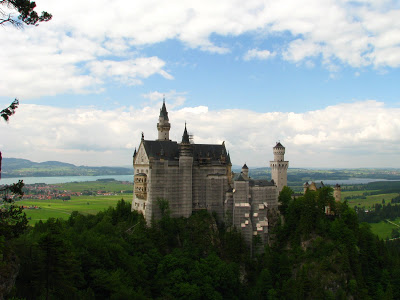 Neuschwanstein castle (New Swan Stone, for the curious) is perhaps the most popular tourist destination in Germany, and easily the most famous castle in the world. So I suppose I was asking for it, in a way, but it seemed ridiculous to live in Munich so long and not go.
So, there I was, sitting on the train Monday morning, horrified by the hordes of noisy, nasal USAmerican tourists, and bemused by my horror. Who do I think I am, repulsed by my fellow countrywomen and -men? But there I was, as I sometimes find myself when confronted with Americans abroad, hiding my book so they wouldn't see it was English. Because then they would talk to me. Somehow, they always want to talk. The novelty of meeting a fellow American abroad seems to astound them as much as it appals me.
When I arrived, there was a three and a half hour wait for the next English tour, a four hour wait for the next German tour, and a two hour wait for the next audio guide tour. Was it available in English? No? German? No? Italian? Rusty, but it'll have to do.
I spent an hour rowing myself around the nearby Alpsee in a small wooden boat. I got some gorgeous blisters, and it was very, very quiet, and wonderfully solitary out in the middle. A large chunk of the freshly-developed antipathy and misanthropy melted away.
I walked up the hill (c. 20 minutes?) to the castle, catching up to and passing one of the horse-drawn carriages on the way (walking = faster and free!).
The tour lasted, I believe, just under half an hour. We were herded about like exceptionally dumb cattle, and chastised if we attempted to take pictures. The major advantage of being on the Italian tour is that everyone tried to take pictures anyway. Italian lackadaisicality battled German hideboundness for about 25 minutes. In general, the Germans won.
What interested me the most was the competitiveness of it all - the pushing and shoving to get on trains, buses. We all wanted our share of beauty, glamour, romance, and we were bound and determined to get it. The cut-throat pursuit of pleasure.
I feel I am being misrepresented. /
re: density and vacuousness
"...margaret was saying that the unique value of paintings is in their ability to do what photographs cannot do, in the same way that the unique value of the novel lies in its ability to do what films cannot do."
I think the fault lies with the plural. I did not mean to argue that paintings or novels were better than films or photos, respectively. Nor that some ideas or topics belong to or are even best expressed by any particular form. Rather, I was musing whether the modern value of these seemingly out-dated and old-fashioned art forms, having been surpassed in the pursuit of "realism" (in the popular imagination if not in point of fact), is that through a sort of non-literal interpretation of something (mood, moment, manatee), a different way of seeing things is made manifest. Is this what all good art does? Probably, yes. But the point, the point being that a great novel is essentially a novel, and not a film. That a film adaptation of a great novel will never be able to express the same essence as that novel. (I tip my hat to Milan Kundera's Immortality for addressing this exact question.) And, though it is less often attempted, vice versa. Of course there are excellent photos and mediocre novels. Taken as read. However, a great work seems to me to have something in it that links it, I would suggest inextricably, to its form.
"...margaret was saying that the unique value of paintings is in their ability to do what photographs cannot do, in the same way that the unique value of the novel lies in its ability to do what films cannot do."
I think the fault lies with the plural. I did not mean to argue that paintings or novels were better than films or photos, respectively. Nor that some ideas or topics belong to or are even best expressed by any particular form. Rather, I was musing whether the modern value of these seemingly out-dated and old-fashioned art forms, having been surpassed in the pursuit of "realism" (in the popular imagination if not in point of fact), is that through a sort of non-literal interpretation of something (mood, moment, manatee), a different way of seeing things is made manifest. Is this what all good art does? Probably, yes. But the point, the point being that a great novel is essentially a novel, and not a film. That a film adaptation of a great novel will never be able to express the same essence as that novel. (I tip my hat to Milan Kundera's Immortality for addressing this exact question.) And, though it is less often attempted, vice versa. Of course there are excellent photos and mediocre novels. Taken as read. However, a great work seems to me to have something in it that links it, I would suggest inextricably, to its form.
quote of the day* /
"I assure you, only the world's least-interesting men read Maxim."
- Seth Stevenson, "The Most Interesting Man in the World," for Slate.com
*I promise not to keep this up indefinitely. I promise I may or may not keep this promise.
- Seth Stevenson, "The Most Interesting Man in the World," for Slate.com
*I promise not to keep this up indefinitely. I promise I may or may not keep this promise.
anti-quote of the day* /
" 'Feminism' had come to seem, well...just the teeniest bit tiresome."
- Terry Castle, quote of the day on DoubleX
Why is everyone so damned intent on taking the joy out of feminism? I know it's trendy, but don't they know how much fun feminism is? Certainly Terry Castle seems aware of the pressing necessity for it still, the deep injustices that it tries to address, draw attention to, remedy. But the light, the also-necessary brightness, the ability to highlight the absurdities of patriarchy, masculinity, femininity, heteronormativity, the invaluable license to laugh at the strictures that terrified and straight-jacketed generations before us. It's invigorating! It's exciting! It's so wholly necessary! Like a telescope looking both into and out at society, history, culture, feminism allows us to focus on things that before had at best been vague blurs. It is equally relevant to micro- and macrocosmic ideas, issues, plans, designs. It makes me use these cheesy metaphors!
I agree with the point that certain strains of academic feminism can become staid, crippling, insular, largely irrelevant. But why does Castle avoid the liberating and embracing notion that feminism is for everybody?
*also not a daily feature
- Terry Castle, quote of the day on DoubleX
Why is everyone so damned intent on taking the joy out of feminism? I know it's trendy, but don't they know how much fun feminism is? Certainly Terry Castle seems aware of the pressing necessity for it still, the deep injustices that it tries to address, draw attention to, remedy. But the light, the also-necessary brightness, the ability to highlight the absurdities of patriarchy, masculinity, femininity, heteronormativity, the invaluable license to laugh at the strictures that terrified and straight-jacketed generations before us. It's invigorating! It's exciting! It's so wholly necessary! Like a telescope looking both into and out at society, history, culture, feminism allows us to focus on things that before had at best been vague blurs. It is equally relevant to micro- and macrocosmic ideas, issues, plans, designs. It makes me use these cheesy metaphors!
I agree with the point that certain strains of academic feminism can become staid, crippling, insular, largely irrelevant. But why does Castle avoid the liberating and embracing notion that feminism is for everybody?
*also not a daily feature
you can't say that about my Freundsprache /
"The German tongue. Fleshy, warped, spit-spraying, purplish and cruel...I sensed a deathly power in the language. I wanted to speak it well, use it as a charm, a protective device. The more I shrank from learning actual words, rules and pronunciation, the more important it seemed that I go forward. What we are reluctant to touch often seems the very fabric of our salvation. But the basic sounds defeated me, the harsh spurting northerness of the words and syllables, the command delivery. Something happened between the back of my tongue and the roof of my mouth that made a mockery of my attempts to sound German words."
- Don DeLillo, White Noise
I know this is the popular opinion in the U.S., easily found among people who have never heard German, except by American actors in Hollywood movies. But I don't find it to be a harsh language. I think there is far more of an emotional/historical memory at work than anything else.
- Don DeLillo, White Noise
I know this is the popular opinion in the U.S., easily found among people who have never heard German, except by American actors in Hollywood movies. But I don't find it to be a harsh language. I think there is far more of an emotional/historical memory at work than anything else.
dream, dream, dream /
really? she could be a supreme court justice? Wow. We should be so lucky. But we probably won't.
quote of the day* /
"He writes of avoiding his desk when inventing, avoiding the connotations of serious endeavor, of earning a living. 'I wish instead,' he writes, 'to be irresponsible, rash, associative, dreamy, impish, brainy, intuitive, and stupid.' Which seems, to me, about the right strategy for our times."
- Allison Arieff on Stephen M. Johnson, "Searching for Value in Ludicrous Ideas"

(pictured above: bike vest)
*not a daily feature
- Allison Arieff on Stephen M. Johnson, "Searching for Value in Ludicrous Ideas"
(pictured above: bike vest)
*not a daily feature
the doorbell saga, exhibit C /

I have a premonition that this will succeed in pleasing no one.
Of course, when my roommate took the one surviving screw to the hardware store, the hardware store lost it. These were the closest replacements available. Frankly, I think it looked better before, with the two screws of matching size and color, even if one did have the wrong head (sorry, no photo available, it was too brief of an interval).
the end, question mark
the apparent nonchalance of prostitutes /
(Amsterdam)
It was more striking than the prostitutes themselves. Sitting or standing behind their floor-to-ceiling windows, lit in pink and red. Dyed blonde, tanned, tattoed, lingerie- or bikini-clad. The same idea of attraction, conformity and repetition. And palpable disinterest. Eating, talking on cell phones. I suppose I expected some kind of show. Dancing on poles, come-hither nonsense. But you get nothing for free, besides the hammering if somewhat inexplicable guilt of voyeurism. The sameness of it all was what hit me hardest. And the heteronormativity. No men in the windows, and I was told that prospective female clients would be turned away. This from a city with a reputation for the largest Pride party in Europe.
How many, if indeed any, are there truly of their own volition? How many had better options that they turned down? The more I read about human trafficking, the more terrified I am that we never abolished slavery. We just pushed it underground.
It was more striking than the prostitutes themselves. Sitting or standing behind their floor-to-ceiling windows, lit in pink and red. Dyed blonde, tanned, tattoed, lingerie- or bikini-clad. The same idea of attraction, conformity and repetition. And palpable disinterest. Eating, talking on cell phones. I suppose I expected some kind of show. Dancing on poles, come-hither nonsense. But you get nothing for free, besides the hammering if somewhat inexplicable guilt of voyeurism. The sameness of it all was what hit me hardest. And the heteronormativity. No men in the windows, and I was told that prospective female clients would be turned away. This from a city with a reputation for the largest Pride party in Europe.
How many, if indeed any, are there truly of their own volition? How many had better options that they turned down? The more I read about human trafficking, the more terrified I am that we never abolished slavery. We just pushed it underground.
the doorbell saga, exhibit B /
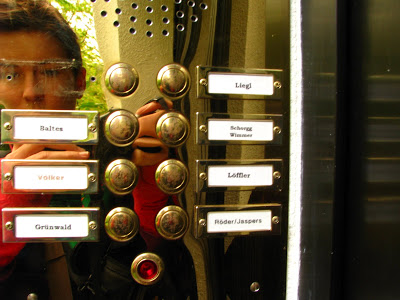
We took it off to try to match the screws.
the doorbell saga, exhibit A /
this was the cause of earlier trouble. The screw pictured below has since been replaced with one of proper size and color.

Unfortunately, of the wrong type. We have again received complaints. Stupidly, we used a screw with a slotted head when we should have used a Phillips. It does clash dreadfully.
Unfortunately, of the wrong type. We have again received complaints. Stupidly, we used a screw with a slotted head when we should have used a Phillips. It does clash dreadfully.
room 101 at the Goldenen Hirschen /
some useful information posted in my hotel room:
"Hospitality and safety are omnipresent throughout our Establishment. Though you may take it for granted that the outbreak of a fire in our building is almost excluded, we are even prepared for such an emergency and request the favor of your kind assistance...Keep your presence of mind..."
"Hospitality and safety are omnipresent throughout our Establishment. Though you may take it for granted that the outbreak of a fire in our building is almost excluded, we are even prepared for such an emergency and request the favor of your kind assistance...Keep your presence of mind..."